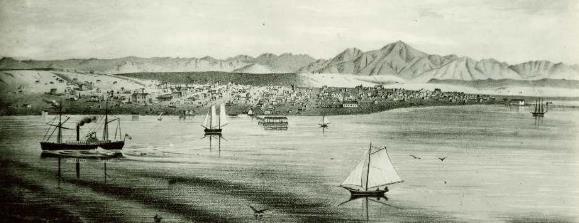

William Heath Davis
Of the new town of San Diego, now the city of San Diego, I can say that I was its founder. –William Heath Davis, interview with San Diego Sun, December 1887.
Often forgotten in San Diego history is the pioneer some historians regard as the true founder of the City of San Diego. William Heath Davis certainly believed he deserved credit for his attempt of 1850, an effort that failed but paved the way for a later city builder named Alonzo E. Horton.
Read the story of San Diego’s founding: The Davis Folly.
The city council signed a contract yesterday with Hatfield, the Moisture Accelerator. He has promised to fill Morena reservoir to overflowing by December 20, 1916, for $10,000. All the councilmen are in favor of the contract except Fay, who says it’s rank foolishness. —San Diego Union.
By the end of 1915, San Diego was in its fifth year of drought. The city reservoirs of Morena and Otay were nearly empty. With water supplies threatened, the nervous City Councilmen gave verbal acceptance to the offer of a “Rainmaker,” Charles M. Hatfield, who boldly pledged to “fill the Morena reservoir to overflowing . . .”
Read the story of The Rainmaker

Mission Valley, flooded in January 1916.
 In a bold headline, the San Diego Union of May 21, 1907, announced a shocking crime: P.S. SPARKMAN MURDERED AT RINCON. The English merchant from the tiny community at the foot of Palomar Mountain was a respected businessman, a well-known friend of the local Indians, and a peaceful man “never known to have a quarrel with anyone.”
Read the complete story of The English Storekeeper at Rincon.
 Last May I wrote a post on City Directories: their value to historical researchers and the need for digitization. These books list personal and business names, addresses, and occupations for most of San Diego County. Now some great news to report. Nearly 40 years of San Diego directories are available online from the Internet Archive.
Several months ago, the Special Collections department of the San Diego Public Library accepted an incredible offer from the Balboa Park Online Collaborative to have these important volumes digitized. The years from 1887 to 1925 were scanned, page by page through the services of the BPOC. Volumes once available only in the California Room at the downtown library, can now be viewed and searched online, or downloaded in a variety of formats.
Click here for San Diego Directories.
Probably the easiest way to use the directories is to read them online. You can flip through the pages or do a search by name. One problem, unfortunately, is that the directory titles don’t always show the year. So here’s a hint. If you look on the right side of the search results you’ll see “sort results by.” Click on “Date” and the volumes will be sorted by year.
If you don’t want to rely on your Internet connection you can also download the entire volumes in pdf, full-text, or other formats. You can even download the directories to a Kindle.

The British clipper ship Darra.
“IT SMACKS OF PIRACY†headlined the San Diego Union on Sunday morning, November 28, 1887. The night before three sailors had been forcibly taken from the British bark Darra as it lay anchored in the harbor. The incident soon known as “The Darra Outrage†would stir up the local water front community and threaten relations with British merchants and sea captains.
Read the complete story of the Darra Outrage.

Clinton L. Byers, City Attorney
Alleged padding of city telephone bills with charges for personal calls by city officials came under scrutiny of the county Grand Jury today as it launched an investigation of “junket†trips taken by City Atty. C. L. Byers and Councilman A. W. Bennett. . .
The mid-1930s were a rocky period for San Diego politics. Careers were made and lost in a matter of months. One of the most prominent political casualties of the era was the city’s chief legal authority: the city attorney, Clinton L. Byers.
Read the entire story of the Embattled City Attorney.
I have pretty eclectic reading tastes but specializing in San Diego history comes with my job. I’ll be posting some thoughts here soon on what’s good to read in local history.
Any current favorites from readers?

Frank Buck, from his autobiography, All in a Lifetime.
The adventures of Frank Buck captivated millions of people throughout the world in the 1930s and 40s. Celebrated to this day for his exploits as a wild animal hunter and trader, Buck is less well known for his brief, tumultuous tenure as director of the San Diego Zoo.
Read the complete story here of Frank Buck in San Diego.
Eyeing the murky, dirt-bottom lily pond in front of the wood lath Botanical Building, the Navy suggested using the 195 x 43 foot basin for swimming and boating lessons. Balboa Park’s governing Board of Park Commissioners–eager to please their military guests–hastened to comply. . .
The story of the Navy Swimming Pool in Balboa Park.

The lily pond in Balboa Park
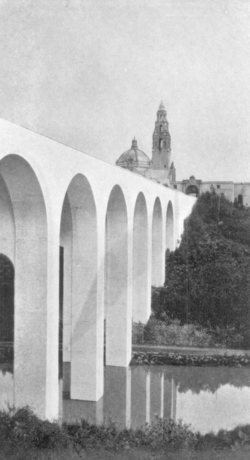 Construction of the bridge began in December 1912 under the supervision of Frank P. Allen, Jr., the exposition’s Director of Works, using the designs of Thomas B. Hunter, a San Francisco engineer. Built for a cost of $225,154, the bridge was an innovative multiple-arched, cantilever structure and the first such bridge in California.
Read the history of this remarkable landmark, the Cabrillo Bridge.



ABOUT
A site for reading and discussion of San Diego history
RECENT POSTS
| M | T | W | T | F | S | S |
|---|---|---|---|---|---|---|
| 1 | 2 | 3 | 4 | 5 | 6 | 7 |
| 8 | 9 | 10 | 11 | 12 | 13 | 14 |
| 15 | 16 | 17 | 18 | 19 | 20 | 21 |
| 22 | 23 | 24 | 25 | 26 | 27 | 28 |
| 29 | 30 | 31 | ||||
Latest book
