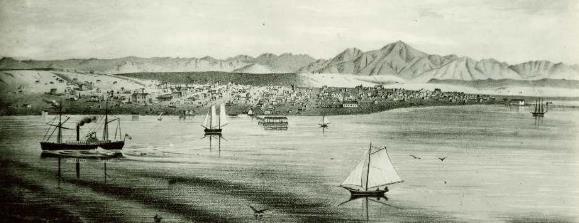
 Scott O’Dell’s novel of a young Indian girl abandoned on harsh San Nicholas Island in the early 1800s is a dramatic story of courage and self-reliance. Published in 1960, Island of the Blue Dolphins would become one of the top twenty selling, young adult books of all time, with over six million copies sold and translations in 28 languages.
The story of Scott O’Dell.

Fishing barge New Point Loma
Sea fishing off the Southern California coast became quite popular in the early 1900s. Anglers lined the piers of coastal towns but envied the fishermen on boats who enjoyed better catches off shore. In the 1920s, fishing barges began to appear. Anchored in deeper waters, the barges provided great fishing but at a more modest cost than the sport boats.
San Diego’s most successful fishing barge was the New Point Loma, a converted fishing schooner. Read more about the Fishing Barges of San Diego.

Police Chief Arthur Hill.
The Police Department got the liquor, fixers got the money, and the Legionnaires laughed. –Abraham Sauer, editor, the San Diego Herald.
I just hung on. . . I saw the other fellows fall and it didn’t make me feel any too good, but there was nothing I could do about it except to hang on tighter. I wouldn’t do it again for love or money. —Seaman Bud Cowart
An airship disaster in May 1932, shocked San Diego. Read about the Akron Tragedy

USS Akron at San Diego, May 1932
Deportation, followed by a Mexican firing squad, may be the fate of some or all of the body of potential revolutionists arrested here by United States government agents yesterday . . . –San Diego Tribune, August 16, 1926
In the summer of 1926, a small army of revolutionaries assembled in Dulzura, California–ready to launch a rebellion in Mexico.

Captured Mexican revolutionaries assembled at Fort Rosecrans.
Read about the Estrada-Insurrectos.
I take pleasure in advising the people of San Diego, that the Santa Fe Company has today awarded a contract for the new passenger station in your city. . . The work will be commenced at once. –A. G. Wells, Atchison, Topeka and Santa Fe Railway, May 23, 1914.
The story of San Diego’s remarkable railroad station, The Santa Fe Depot.

Santa Fe depot, circa 1920.
The last and largest whale captured this season made an interesting chase. Her blowing was observed by the crews of the four boats almost simultaneously. The moment she was seen the orders came quick and sharp from the boatswain in command, and at once the men bent to their oars with a will, making their boat bound over the water with such speed as would astonish a green hand.Â
–San Diego Union, January 11, 1872
Read the story of The Whales of San Diego Bay.

 Grossmont . . . It is the chosen spot of many of the gifted in art, literature and science as a place where they may establish a quiet home, with delightful climate, beauty of surroundings and the peace that comes from dwelling in high places. –Overland Monthly, March 1912
One of San Diego’s most picturesque communities is named for a man poorly remembered today. William B. Gross, namesake of Grossmont, came to San Diego in about 1903 after a chance meeting with Ed Fletcher, a young produce salesman with an eye for opportunity . . .
Click here for the story of Grossmont.

Rebuilt by the pennies of school children and as sound as on that autumn day more than 135 years ago when she slid down the ways . . . the U.S.S. Constitution, most famous vessel in the American navy, is due alongside Broadway pier this forenoon. —San Diego Union, January 21, 1933.
In the winter of 1933, thousands of San Diegans flocked to the foot of Broadway to see the most famous naval ship in U.S. history. Read about Old Ironsides in San Diego
 San Diego is three years away from a new Central Library. Getting libraries built in San Diego is a historic problem. Follow the link below for a six-minute video on the plans for the New Central and a history of difficulties in the past: http://www.kpbs.org/news/2010/nov/12/downtown-library-always-too-popular-too-small/



ABOUT
A site for reading and discussion of San Diego history
RECENT POSTS
| M | T | W | T | F | S | S |
|---|---|---|---|---|---|---|
| 1 | 2 | 3 | 4 | 5 | 6 | 7 |
| 8 | 9 | 10 | 11 | 12 | 13 | 14 |
| 15 | 16 | 17 | 18 | 19 | 20 | 21 |
| 22 | 23 | 24 | 25 | 26 | 27 | 28 |
| 29 | 30 | 31 | ||||
Latest book
