
Luman H. Gaskill
The personal record books of San Diego pioneers are often a surprising source of contemporary lore. Business ledgers–sometimes used like personal filing cabinets, recorded everything from commercial activities and receipts, to family history and kitchen recipes.
Campo pioneer Luman Gaskill kept such a ledger book handy, writing entries for several decades. Luman would serve as the town storekeeper, banker, marshal, justice of the peace, dentist, and doctor. His book would become a remarkable compendium of folk remedies and household notes, as well as store receipts and accounts.
Click here for “Dr. Gaskill’s” best recipes for Frontier Medicine.
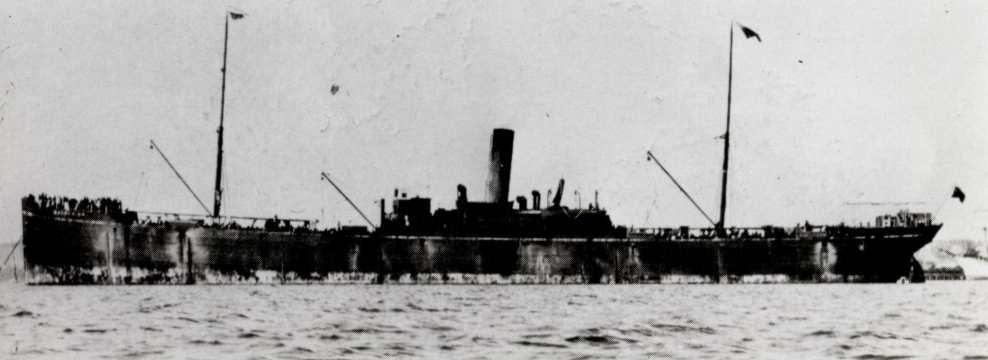
Bold adventure, lurking danger, mutiny, death—the story of all this, running like some tale of the days of the Spanish conquests of the New World, was brought to San Diego today by the big tramp steamer Maori King.  Â
Click here for the story of the Maori King.

The tramp steamer Maori King.
Personally, I would abolish Halloween, but the city council has taken other steps that we hope will be effective . . .
 In World War II, Halloween festivities would be a little different in San Diego. Read how the city coped with a holiday under wartime conditions: Halloween in Wartime.
Scores of Americans found themselves suddenly stranded in Mexico last night when the famous “hole in the fence” at the border was closed yesterday afternoon without warning. . . Protest was made to customs and immigration officials on duty, but the officers said they could do nothing about it . . .
Read about The Hole in the Fence.

“A big rain is coming,” predicted Henry Cooper, Escondido’s celebrated, amateur weather prognosticator. The Escondido Weather Prophet, as he was known, spoke in early February 1927, predicting a major storm for later in the month. “We shall have copious rains all along the coast,” Cooper declared, “with assured runoff from a heavy mantle of snow in the mountains.”
Read the story of one of San Diego’s biggest rain years: the Flood of 1927.

Mission Valley under water, Feb. 1927.
The flagship of the Pacific Squadron arrived unexpectedly in San Diego in late December 1891. “Our presence is probably a surprise to you,” said the ship’s captain, Rear Admiral George Brown. “We were ordered to San Diego and here we are. We shall take on about 250 tons of coal and will then be on waiting orders.”
Within days, Brown’s ship was joined by another cruiser, the USS Charleston. The ships would spend the next six weeks in San Diego.
The story of the White Squadron.

USS San Francisco

Cabrillo Statue
“I didn’t steal it,” declared Senator Fletcher with ruffled dignity. “But there were threats of lawsuit and an injunction, so with a gang of men, a derrick and a truck, I took quick action, and possession is nine points of the law.”
The story of San Diego’s famed “Stolen” Cabrillo Statue.

Sutherland abandoned, 1928.
To look at it now, solidly in place, you would never know its disturbed history. The broken course of the Sutherland project is one of those fantastic things that could only happen here . . .
The story of a dam that took 25 years to build: the Dam Fiasco.
 Lasting only six months, the mayoral term of Dr. Rutherford B. Irones was one of the shortest in San Diego history. It was certainly the strangest.
This is a story about a mayor who left city hall for a jail cell. The Royal Coach Affair.

Each fall, thousands of tourists make their way to the scenic hill town of Julian, California.  Since the late 1800s, October has been “apple time” in historic Julian.  Click here for the history of The Apples of Julian.



ABOUT
A site for reading and discussion of San Diego history
RECENT POSTS
| M | T | W | T | F | S | S |
|---|---|---|---|---|---|---|
| 1 | 2 | 3 | 4 | 5 | 6 | 7 |
| 8 | 9 | 10 | 11 | 12 | 13 | 14 |
| 15 | 16 | 17 | 18 | 19 | 20 | 21 |
| 22 | 23 | 24 | 25 | 26 | 27 | 28 |
| 29 | 30 | 31 | ||||
Latest book
