
Water flowing from the San Diego Aqueduct into the San Vicente Reservoir.
San Diego today imports about 80% of its water supply. But until 1947 all of our water came from local wells and reservoirs. This article explains how our addiction to outside water supplies began just after World War II: The story of the San Diego Aqueduct.

The notorious “Russian Mike”
In San Diego’s notorious Stingaree district of the 1890s, liquor and violence flowed freely in dozens of saloons south of H Street (Market). One of the more disreputable dives was the Pacific Squadron Saloon on the corner of 4th and J streets, where a homicide involving alcohol, a cheap gun, and a character named Russian Mike, drew rapt attention from San Diegans in the spring of 1899. Read the story of Russian Mike.

A bold, daring and successful attempt at jail breaking occurred at the county jail this morning before daylight. . . Four desperate characters, conspired together to break for liberty, and after careful, premeditated plans, succeeded in gaining liberty. . .
Read about the first successful escape from the San Diego County jail: Jail Break
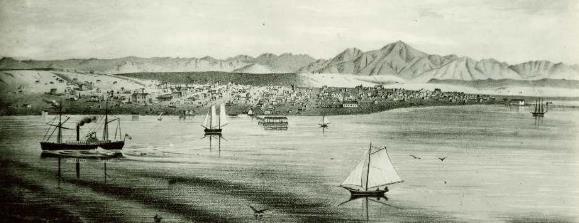
July 29 – 8 to meridian. At 10:30 hauled up courses, standing in for harbor of San Diego. At11:30 came in to 9½ fathoms; hoisted out boats . . . At 3:40 the launch and Alligator under command of Lieutenant Rowan, and the Marine Guard under Lieutenant Maddox, left the ship to take possession of the town of San Diego.
–Log of the USS Cyane.

Read the story of the first flag raising over San Diego in 1846: Raising the flag

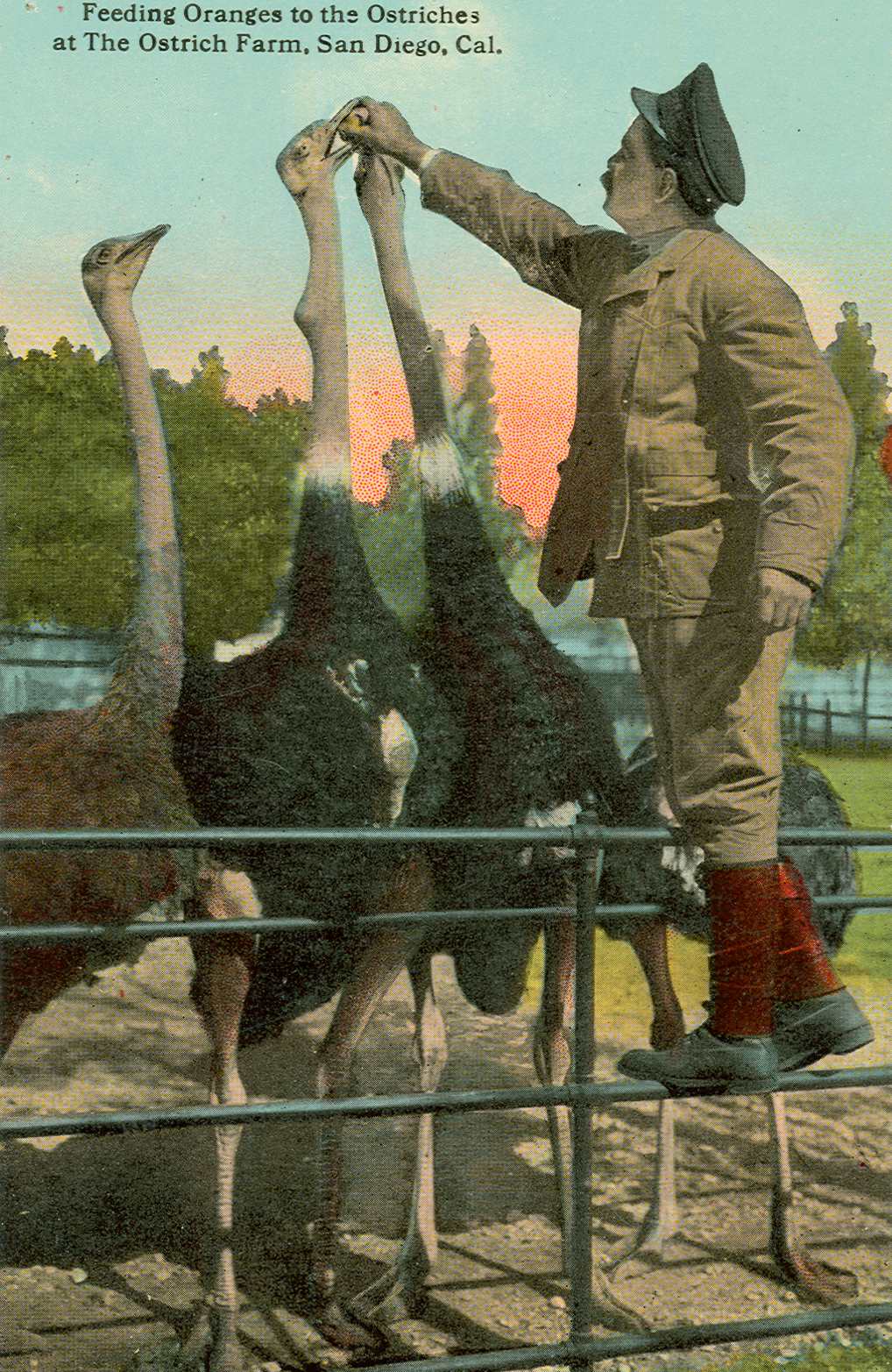
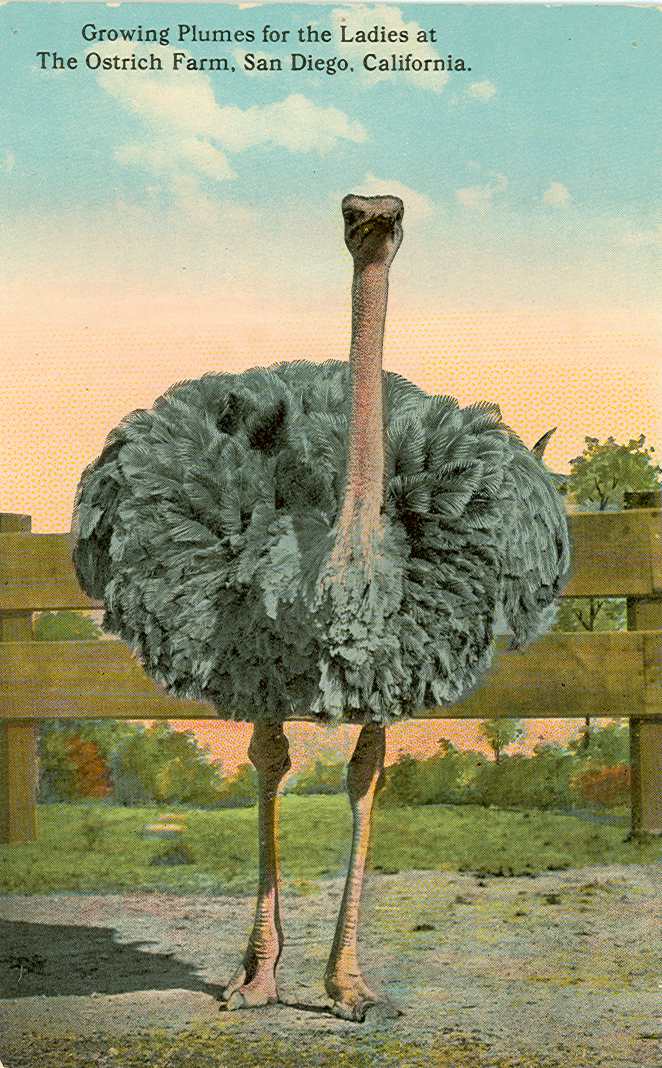
Ostrich farms were big business a century ago and the giant birds prospered in San Diego. Read more about the Ostriches.
Southern California families, especially homeowners, are currently pondering the question of their lives: To build or not to build a place to hide from nuclear attack. . .

A backyard bomb shelter.
Read here about “shelter mania” in San Diego: Fallout .

Captains and officers of San Diego’s “Yippie” boats.
We called ourselves the pork chop express. We carried meat and vegetables from Pearl Harbor all over the central Pacific. . . Sometimes we’d come back from an 1,800 jaunt, load up with pork chops and go right out again. We were so slow that almost anything could have caught up with us and sunk us.
The story of San Diego’s tuna fleet in World War II: The Pork Chop Express.
The city of San Diego has been the namesake for two U.S. Navy ships with distinguished careers in the two world wars. The armored cruiser USS San Diego served in World War I before its sinking by a German mine off the New York coast in 1918. Another USS San Diego would fight in World War II, remembered by San Diego author Fred Whitmore as “the unbeatable ship that nobody ever heard of.” Read more about the USS San Diego of World War II.

They said they would blow my shop to atoms, burn my house, kill me and my family . . . Three fellows came to my shop [and] warned me to quit or I would suffer, and they kept their word.    –George H. Schmidt, blacksmith.
Read about Dynamite Outrage.

San Diego Union, May 25, 1892
Newspaper obituaries and death notices are often a first step in uncovering valuable family history information. In the California Room of the San Diego Public Library, researchers can search a microfiche index of the San Diego Union to look for obituaries. A “hit†in fiche will reveal the exact newspaper date, page and column, of the obituary. The obituary or death notice can then be found on microfilm in the Newspaper Room.
The newspaper indexing has an interesting history. Librarians at the downtown Carnegie Library (the site of today’s Central Library) began creating the subject index in 1930.  The subject entries were laboriously typed on 3 x 5 cards to create a massive card catalog. Eventually, the cards were photographed and the film was printed on microfiche, which researchers now use in the California Room.
The fiche covers much of San Diego history. The Herald was indexed (1851-1860) and the Union from 1868 to 1983. The Newsbank database in the Newspaper Room carries the indexing forward since 1983.
Unfortunately, there’s a major hole in the indexing.  The “infamous gap†from 1903 to 1930 occurred when the library ran out of funds. Staff time became too expensive and the indexing project ended without completion.
The current California Room staff has been slowly filling “the gap†for the all-important obituaries and death notices by entering the missing information into an Access database. So far, about fourteen years of the gap have been filled in. A pdf version of the database is available here: Index to Deaths and Obituaries



ABOUT
A site for reading and discussion of San Diego history
RECENT POSTS
| M | T | W | T | F | S | S |
|---|---|---|---|---|---|---|
| 1 | 2 | 3 | 4 | 5 | 6 | 7 |
| 8 | 9 | 10 | 11 | 12 | 13 | 14 |
| 15 | 16 | 17 | 18 | 19 | 20 | 21 |
| 22 | 23 | 24 | 25 | 26 | 27 | 28 |
| 29 | 30 | 31 | ||||
Latest book
