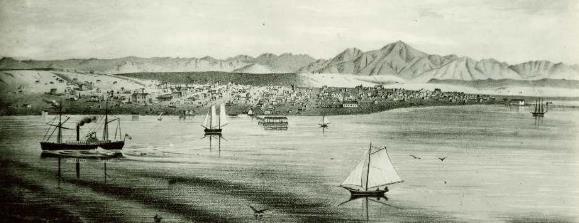
Monday through Friday my “real†job is watching over the California Room at San Diego’s  downtown Central Library. Among many collections of note here are the business directories, dating from the late 1880s all the way up to 1984. Researchers have long appreciated the historical value of these thick volumes—often known as the “Polk Directories‖which list personal and business names, addresses, and occupations for most of San Diego County. They are invaluable for studying local family or business history, and they are used heavily.
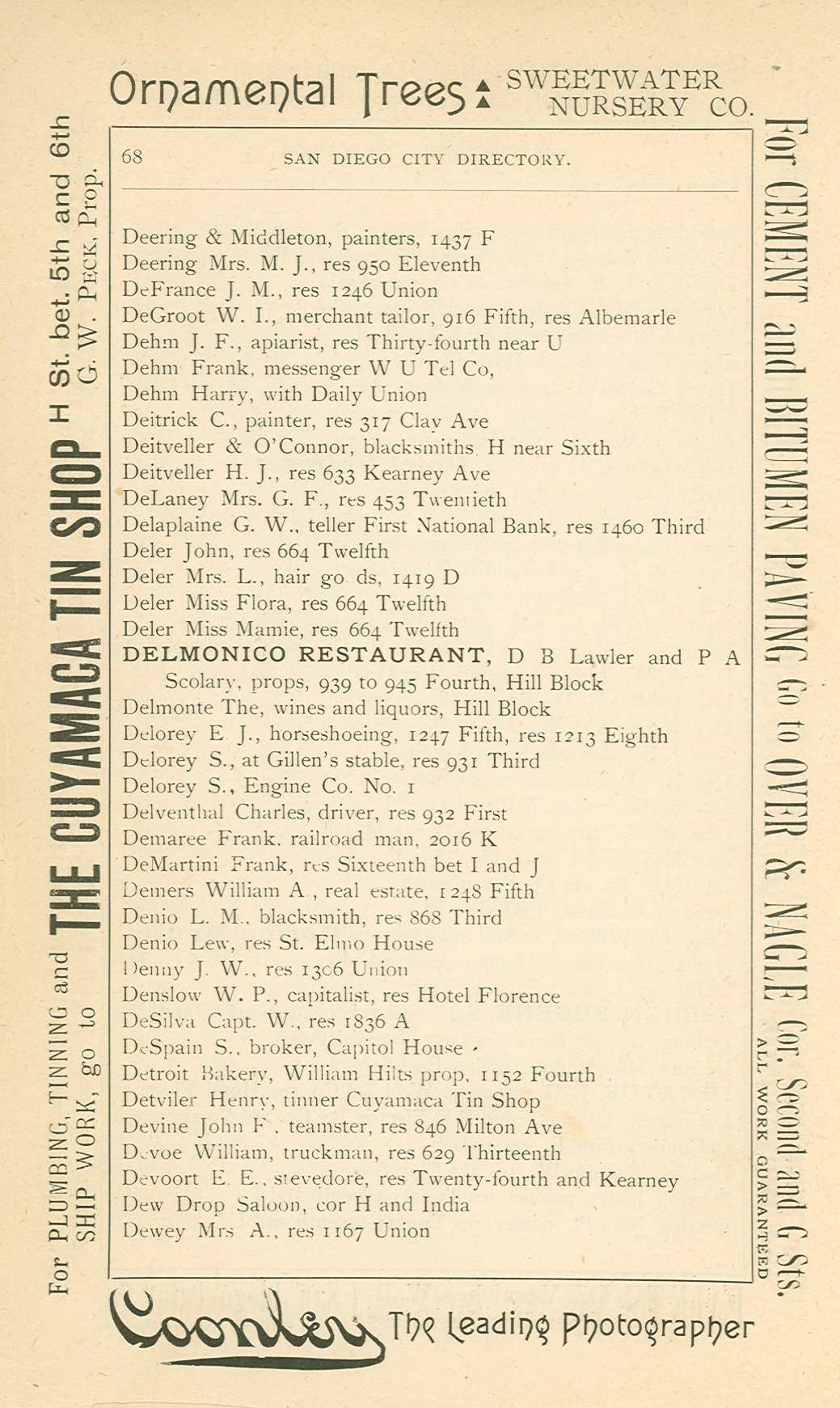
The popularity of our Polks has been a bit of a problem. Paper and bindings wear out, of course, and we have had to pull a few of our more popular volumes just to prevent their total destruction. But a solution has appeared.
In the last two months the library has been working with the San Diego Genealogical Society to digitize the directories. The Genealogical Society’s R. J. Christensen has personally scanned over thirty of our earliest books, ensuring the preservation of the images. The next step is to index the pdf files, which will give us quick name access to online copies of the directories. The Society is now working with Ancestry.com to make this last important step possible. Stay tuned . . .
–Rick

Poster for the Sells Brothers Circus.
In the late 1800s, the arrival of the circus was a special event for the entire community. In San Diego, everyone came to see the show.
Read more about the Circus.
When I was at San Diego, a great many complaints were made by citizens there, and persons arriving from the Gila, of a gang of lawless men who had established a ferry over the Colorado, where not only they practised the greatest extortions, but committed murders and robberies . . .
Read about the Glanton gang at the Yuma Crossing: The Scalp Hunters.

The Yuma crossing
The philanthropist Andrew Carnegie funded the construction of 1,689 libraries in the United States between 1883 and 1929. San Diego was the site of the first Carnegie library in California.
Read more about the Carnegie Library in San Diego and see the film below.:

Cannery workers at the Cohn-Hopkins Company.
We ate lunch, but we didn’t have a break for dinner. We worked straight through. It was pretty hard . . . sometimes there was only two or three hours of work, it just depended on how much fish the cannery had, how many boats came in . . . We were only paid 33 cents an hour.
Read more about the Canneries.
 The arrival of the British tall ship Dudhope in San Diego harbor on November 30, 1914 was an impressive sight. Describing her “massive yards and mast and the white sails hauled tight by the brisk breeze,” the Union called the 2000-ton tall ship a “marine spectacle.”
The steel-hulled bark had the historic distinction being the last cargo-carrying windjammer to enter San Diego via the storied Cape Horn route. But the ship would be better remembered for a surprising mutiny.
Read more about “The Dudhope Mutiny”

A redwood pipe past its prime.
There wasn’t a lawn in the city. But some people went without baths so they could water their pet shrubs. Everybody with money left town. Those who remained became water experts . . .
Read about the Wooden Pipeline to San Diego.

The closing of the Stingaree.
Strolling down Fifth Street any evening, the ear is rasped by the notes from asthmatic pianos, discordant banjos and fiddles, and half-drunken voices that sing boisterous and ribald songs. The eye is pained to see one, two, or perhaps three men on each corner, so intoxicated that they can barely stand . . . the lower Fifth Street in San Diego is fully as bad, if not worse than the notorious Barbary Coast district of San Francisco . . .
Read about the Stingaree.
The Dulzura district is the most extensive and richest gold bearing deposit in the world today. –Col. J. Lovick Johnson, mining engineer.
A surprising gold strike set off a stampede in March 1908.
Read more: Dulzura Gold Rush

Miners on the road in Dulzura
 Within the next twenty days San Diego harbor will assume a warlike appearance, for twenty vessels of the navy, including the two submarines Grampus and Pike . . . will be in the waters of the inner bay . . .
Go to submarines.



ABOUT
A site for reading and discussion of San Diego history
RECENT POSTS
| M | T | W | T | F | S | S |
|---|---|---|---|---|---|---|
| 1 | 2 | 3 | 4 | 5 | 6 | 7 |
| 8 | 9 | 10 | 11 | 12 | 13 | 14 |
| 15 | 16 | 17 | 18 | 19 | 20 | 21 |
| 22 | 23 | 24 | 25 | 26 | 27 | 28 |
| 29 | 30 | 31 | ||||
Latest book
